
ADA Handrail Requirements for Commercial Stairs and Ramps
Handrails at 34 to 38 inches with a 1-1/4 to 2 inch grip and 12-inch extensions, and a 42-inch guard on top of that.

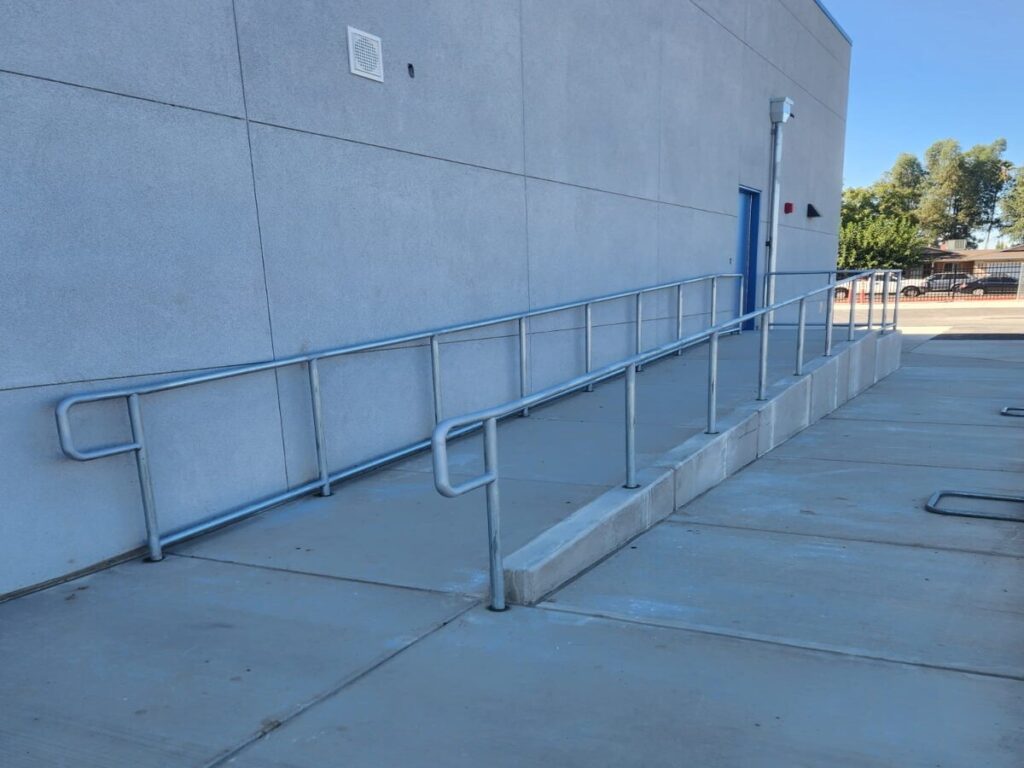
A commercial stair usually carries two rails at two heights, and they come from two different rulebooks. ADA covers the handrail you grip: 34 to 38 inches high, a shape your hand closes around, and extensions past the top and bottom step. The building code covers the guard at the open edge: at least 42 inches, with openings a 4-inch sphere cannot pass.
In this guide
ADA vs the building code
ADA is a federal accessibility standard, and it governs the handrail on an accessible route: the stairs and ramps people use to get into and through a building. The 2025 California Building Code governs the guard: Section 1015 covers the barrier at an open edge more than 30 inches above the floor or grade below. Your city or county may add to it.
Handrail height: 34 to 38 inches
The graspable handrail sits 34 to 38 inches above the stair nosings, the ramp surface, or the walking surface, measured to the top of the rail. That range is the same under ADA and the building code. The rail runs continuously along the flight, and on an accessible route it goes on both sides. Continuous means it does not stop and restart at a post in the middle of the run.
The grip: a measured spec
A round pipe between 1-1/4 and 2 inches across passes, because a hand closes all the way around it. Schedule 40 steel pipe comes in sizes that fall in that range. The gripping surface also has to be continuous, with nothing in the way of a hand sliding along it.
Extensions past the steps
The handrail continues past the top and the bottom of the stair. On a ramp the rail runs 12 inches past the top and the bottom. On a stair it extends 12 inches horizontally past the top riser, and at the bottom it continues for one tread depth past the last riser before it turns.
The guard is a different rail
A guard is the barrier at an open edge: a stair side, a landing, a raised walkway, a mezzanine. In a commercial building it is at least 42 inches tall, and the openings have to be tight enough that a 4-inch sphere cannot pass through up to 36 inches, a 4-3/8-inch sphere from 36 to 42 inches, and a 6-inch sphere at the triangle formed by the riser, the tread and the bottom rail of a stair. Inside those limits the infill is open: vertical pickets, a welded steel mesh panel, or ornamental iron work.
Ramps
A ramp needs handrails on both sides once it rises more than 6 inches. Same 34 to 38 inch height, same graspable shape, same extensions. Ramps carry their own slope and landing rules on top of that, but the handrail spec matches the stairs.
What we build it from
We build handrails, guards, and ADA ramp rails in steel and iron, welded: Schedule 40 pipe for the graspable handrails, tube and pickets for the guards. Railings come in galvanized pipe, square tube, powder-coated steel, or decorative ironwork, and the posts can be core-drilled, base-plated, welded to embed plates, or set in footings in soil. A railing runs $80 to $120 a foot installed.
Frequently asked questions
How high does a handrail have to be?
34 to 38 inches, measured from the stair nosing, the ramp surface, or the floor up to the top of the rail, under ADA and the building code both.
What is the difference between a handrail and a guard?
A handrail is the graspable rail you hold, at 34 to 38 inches. A guard is the barrier at an open edge, at least 42 inches in a commercial building, with openings a 4-inch sphere cannot pass.
What diameter does an ADA handrail have to be?
A round gripping surface between 1-1/4 and 2 inches across, or a shape with the same graspability. Schedule 40 steel pipe comes in sizes that fit.
Do handrails have to extend past the stairs?
Yes. On stairs, 12 inches past the top riser and one tread depth past the bottom riser. On ramps, 12 inches past the top and the bottom.
How tall is a commercial guardrail?
At least 42 inches, with the openings sized so a 4-inch sphere cannot pass through.
When does a ramp need handrails?
Once it rises more than 6 inches, on both sides, at 34 to 38 inches with the same extensions.
Do you pull the permit?
No. The owner or the GC handles the permit with the local building department.
Can an existing railing be brought up to spec?
Sometimes. A guard that is tall enough can take a graspable pipe handrail added at 34 to 38 inches with the extensions. A railing that is too low, or that has nothing sound to attach to, gets replaced instead of repaired.
Get a price on a handrail or guardrail
Send your plans, or photos of the stairs or the ramp with a rough length, and we will price it.
REQUEST A QUOTE