
What Is a Bollard, and When Does Your Property Need One?
Fixed or removable steel bollards stand about 4 feet above grade, and several fixed posts run $530 to $940 a post installed.

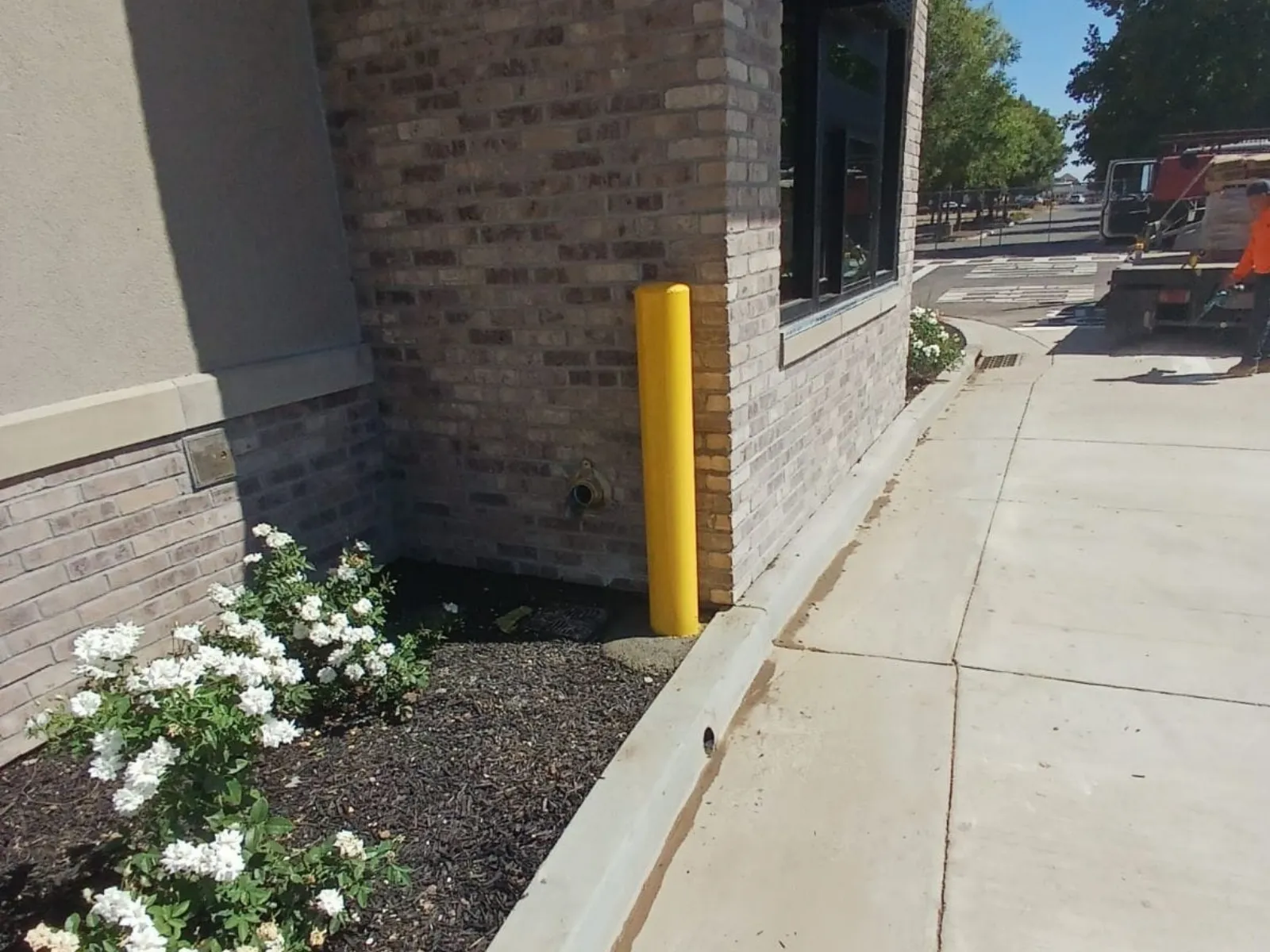
A bollard is a short steel post set in concrete to take a vehicle hit so the thing behind it does not. Most of the ones we set are 4 to 6 inch pipe, about 4 feet above grade, filled with concrete or left hollow. In dirt the post goes into a footing about 3 feet deep. In a slab it gets core-drilled through the concrete. Several fixed posts run $530 to $940 a post installed.
Fixed and removable
Fixed bollards are set permanently in the ground at storefronts, docks, equipment and any other spot a vehicle can reach, and they cost the least per post.
A removable bollard drops into a sleeve set in the concrete and lifts out at fire lanes, driveways and other openings that have to clear. The post locks to the sleeve with welded tabs and a padlock, a welded chain, or a twist-open lock. The sleeve and the lock add fabrication, so it costs more.
When you need one
Bollards are used in cases like these:
- A car keeps clipping the building corner, a column, or the storefront glass.
- A fuel island, gas meter, generator, transformer, or air and water station sits next to a drive aisle.
- Drive-through menu boards and pickup windows.
- Loading docks and warehouse doors that trucks and forklifts back into.
- Walkways and ADA routes that run alongside a drive aisle.
- Inside a dumpster enclosure, so the truck hits the bollard and not the gate post.
- After a vehicle has already hit something, and the owner or the insurer wants it protected before it happens again.
Which one fits
Most sites want fixed steel: lowest cost per post, and it stops the vehicle. Removable makes sense only where the opening genuinely has to clear, because the sleeve costs more than a plain footing. Flexible is for guiding traffic, and where that is all the spot needs we say so, because it costs less than steel. Tell us what is happening at the spot and we will tell you which one it takes. The removable type is covered on its own in removable bollards.
How they go in
Where there is dirt, we dig and pour a concrete footing about 3 feet deep. Where there is a slab, the post is core-drilled through it, as deep as the concrete goes. A bollard can also be bolted to the slab, and a bolted bollard is not as strong as one set in concrete. The pipe can be filled with concrete or left hollow. Bollards can be painted safety yellow or another color, powder coated, or left galvanized.
Before any digging or drilling we call 811 to get the public lines marked. 811 does not mark private lines, so irrigation, drip lines and old conduit are yours to point out.
What they cost
Several fixed steel bollards run about $530 to $940 a post installed, and one bollard on its own runs about $950 to $1,000.
FAQs
Are bollards filled with concrete?
Some are. A bollard can be filled with concrete or left hollow, depending on the job.
What pipe are bollards made of?
We usually set Schedule 40 steel pipe, 4 to 6 inches across.
Can a bollard stop a car?
A concrete-filled steel bollard set in concrete stops a vehicle at parking-lot speed.
What about flexible posts?
Flexible posts are rubber or polymer. They spring back after a car pushes them over and are used to mark lanes. They will not hold back a vehicle.
How deep does a bollard go?
A footed post sits in a concrete footing about 3 feet deep. A core-drilled post goes through the slab, as deep as the concrete goes.
Can I get removable bollards?
Yes. The post drops into a ground sleeve set in concrete, locks at grade with a padlock, and lifts out when the opening has to be clear. They run $950 to $1,000 and up per post.
Do I need a permit for bollards?
That depends on the city. When a permit is needed, the owner or the general contractor pulls it; we do not.
What finishes are available?
Painted, including safety yellow, powder coated in another color, or galvanized.
Get a price on bollards
Send a photo of the spot, what it is going into, and how many, and we will price it.
REQUEST A QUOTE